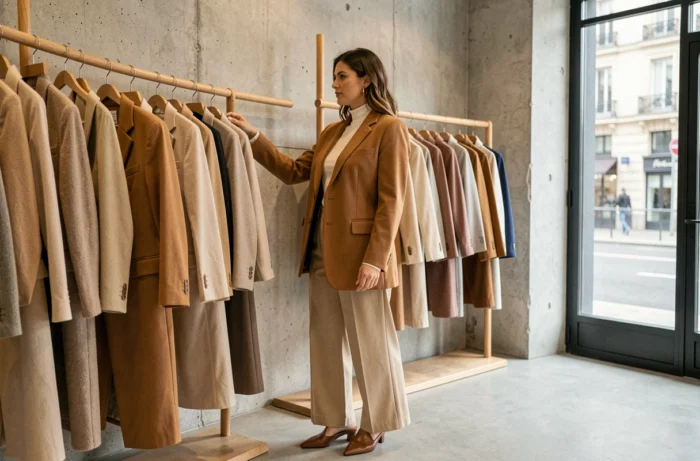
When you open your wardrobe in mid-September and realize that half of the pieces no longer match what you see in the window, the question isn’t about buying everything new. Instead, you look for a few adjustments that give a current look without emptying your bank account. The fashion trends for the autumn-winter season guide these choices, provided you know which ones are worth it and which will remain on the racks.
Contrasting materials: the real lever to modernize an autumn-winter look
Competitors talk a lot about colors and prints. We prefer to start with what concretely changes the perception of an outfit: the contrast of materials. Wearing a thick knit sweater with smooth leather pants, or pairing a tweed jacket with a satin skirt, creates a visual contrast that color alone does not produce.
Recent analyses for autumn-winter highlight this return to contrasts of textures and structured volumes. In practice, you layer a matte piece with a shiny piece, or a fluid fabric with a rigid one. The result works well both in the office and in the evening.
To follow fashion trends on Absolutis, you find this logic of play between raw materials and refined finishes that structure the season’s collections.
One practical tip: before buying a new piece, check if it brings a texture that is absent from your wardrobe. A boiled wool coat does not have the same effect as a fine cloth coat, even with the same cut. It’s the material that makes the difference, not the silhouette.

Structured jackets and coats: the pieces that carry the whole season
You can change your sweater every day, but it’s the jacket or coat that you see first. This season, the volumes are expanding: pronounced shoulders, slightly oversized cuts, lengths that fall below the knee. The enveloping garment, sometimes referred to as a “cocoon garment,” is establishing itself as a central piece.
The cape and long coat as alternatives to the jacket
The cape, short or long, is making a comeback in collections. It offers a silhouette different from the classic jacket and can be easily worn over various outfits. The long wool coat remains a reliable investment: it transcends seasons without losing relevance.
To choose between the two, consider your daily use. The cape is better suited for someone who moves little outdoors (short trips, car). The long coat is more versatile for daily use in the city or on public transport.
The trench and short jacket for mid-season
Between the light sweater of September and the coat of December, there are two months to cover. The short trench and the colorful short jacket fill this gap. They are worn open with a fine turtleneck or closed over a simple t-shirt.
Reviews vary on the durability of short jackets at low prices: it is recommended to check the lining and seam finishes before purchase, especially on entry-level models.
Color and pattern guide to adopt this autumn
On the palette side, the season is organized around two families that coexist without mixing.
- Earthy warm tones (camel, rust, chocolate) work in a total look or as a neutral base for brighter accessories.
- Saturated shades (deep burgundy, forest green, midnight blue) bring intensity without resorting to black as a default.
- Butter yellow, spotted as early as spring, continues into autumn in the form of accessories or lightweight knits worn as an intermediate layer.
As for patterns, tartan and animal prints remain present, but their use has evolved. They are used in small touches (a scarf, a visible lining) rather than as the main piece. One strong pattern per outfit is enough to avoid a costume effect.

Building a sustainable style: beyond seasonal trends
Fashion trends change every six months, but European regulations are now pushing brands towards greater transparency regarding their products. The ESPR (EU) 2024/1781 regulation, which came into effect on July 18, 2024, ultimately provides for a digital passport for textile products that includes fiber composition, origin, and recycling information.
Textiles are among the priority categories of the European work plan 2025-2030. There is not yet a definitive mandatory date for this textile passport, but the direction is clear: we will increasingly know exactly what we are buying.
What this concretely changes for the consumer
The destruction of unsold textiles is entering a new regulatory phase at the European level. Extended producer responsibility specifically extends to textiles, increasing pressure on brands regarding collection, sorting, and reuse.
In practice, it is beneficial to prioritize:
- Pieces with clearly displayed composition (percentage of natural fibers, origin of weaving).
- Brands that already offer take-back or repair programs.
- Quality basics (a good pair of jeans, a dense knit sweater, a well-cut coat) that last through multiple seasons without losing shape.
Investing in fewer, better-chosen pieces is no longer just a stylist’s advice; it is what regulations are pushing the entire market towards.
Three strategic purchases for the autumn-winter season
If we had to summarize the priorities into three pieces to look for this season, here’s what stands out.
A coat or jacket with a structured cut, in a material that contrasts with the rest of the wardrobe. It’s the visible piece, the one that defines the overall style.
An oversized textured knit sweater, worn tucked into high-waisted pants or left loose over straight jeans. The sweater remains the most worn piece between October and March.
A mid-length dress in a dense enough fabric to fit under a coat without wrinkling. Worn with flat ankle boots, it replaces the pants-blouse combo on days when you want to simplify the look.
Each season brings its share of new items, but the pieces that last are those that integrate with what you already own. It’s better to make a thoughtful purchase each month than to go on a shopping spree at the beginning of the season for pieces that won’t be worn again in February.


