
The acronym PMR does not refer to a medical status or a fixed administrative category. It encompasses all individuals who experience difficulties in their mobility, whether the cause is permanent, temporary, or situational. A wheelchair user, a pregnant woman, a traveler carrying luggage, or an elderly person with a cane all fall under this definition. Understanding this scope changes the way we conceive accessibility in buildings, roadways, and public spaces.
End of Ad’AP: Immediate Compliance for ERP Since September 2024
The scheduled accessibility agendas (Ad’AP), established after the 2005 law, provided public establishments with a timeline for achieving accessibility that could extend up to nine years. Since September 2024, the first nine-year Ad’APs have expired. The logic has shifted: the concerned ERP must be compliant immediately, without any grace period.
In practice, inspections have intensified. Possible administrative sanctions range from fines to formal notices, and can even lead to administrative closure in the most serious cases. Small ERPs (shops, private practices, restaurants) are the most exposed, as many had postponed work to the limit of the Ad’AP timeline.
We observe on the ground that many managers are discovering this situation late. An accessibility diagnosis conducted by an accredited control office remains the first reflex to adopt in order to identify residual non-compliances and prioritize work according to their regulatory impact. The issue surrounding PMR disability in France goes beyond mere compliance: it engages the legal responsibility of the manager.
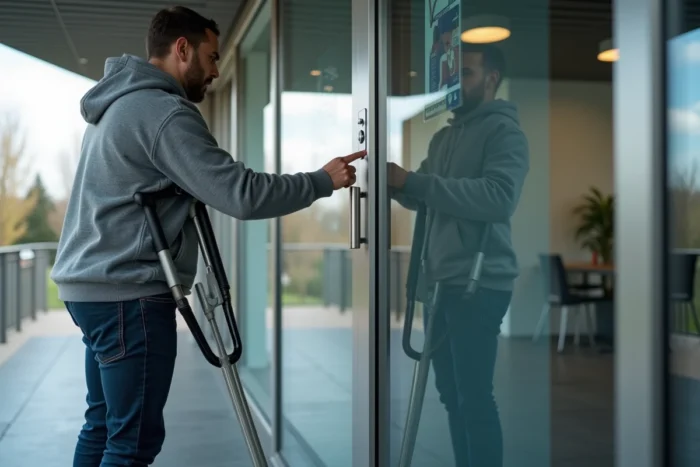
Accessibility of Workplaces: What Changes in October 2026
Starting from October 1, 2026, work carried out in professional premises will need to incorporate enhanced accessibility obligations. Renovation of restrooms, addition of ramps at entrances, modification of internal circulation: any significant intervention will trigger PMR compliance.
This evolution directly affects companies that until now were only subject to the labor code regulations on workplace arrangements. The scope expands to common areas, access, and shared equipment. Employers planning renovations before this date should anticipate upcoming standards to avoid a double project.
Points of Caution for Project Owners
- Check if the renovation project exceeds the threshold triggering the obligation for accessibility compliance by consulting the applicable decree for the type of building
- Integrate passage widths (doors, corridors), control heights, and characteristics of accessible restrooms from the design phase
- Allocate a specific budget for PMR equipment (grab bars, tactile signage, podotactile surfaces) that may not always be included in standard renovation quotes
Digital Accessibility of Public Services: A Persistent Blind Spot
Accessibility is not limited to buildings and roadways. Digital public services (online procedures, institutional websites, mobile applications) are subject to the General Reference for Improving Accessibility (RGAA). Obligations are gradually tightening, with an expected expansion to the private sector for certain services.
A significant proportion of public websites still do not meet RGAA criteria, which directly penalizes users with visual, cognitive, or motor disabilities. Keyboard navigation, compatibility with screen readers, color contrasts: the most frequent shortcomings affect basic functions.
We recommend that local authorities and public space managers do not separate physical accessibility from digital accessibility. An ERP can be perfectly compliant architecturally while offering a reservation site that is unusable for a visually impaired person. PMR accessibility is a chain, and the digital link is often the weakest.
Roadways and Public Spaces: Technical Standards Often Poorly Applied
Roadway adaptations for PMR follow precise specifications: podotactile strips, curb cuts, audible signals, minimum pathway width. On paper, obligations have existed since the 2005 law and its implementing decrees. In practice, the quality of implementation varies significantly from one municipality to another.
The recurring issues we identify during roadway audits affect several areas:
- Uneven paving stones or joints that are too wide, blocking wheelchair wheels or canes
- Vigilance awakening strips installed without respecting the regulatory visual contrast with the surrounding surface
- Curb cuts with slopes exceeding the regulatory threshold or presenting a height difference greater than two centimeters
- Pedestrian signals lacking sound signals at busy intersections
Local authorities undertaking roadway work are required to integrate accessibility compliance into every operation. A simple renewal of sidewalk surfacing triggers this obligation. Ignoring this point exposes the municipality to legal challenges from user associations.

The distinction between disability and reduced mobility remains poorly understood by many public and private actors. PMR does not mean only wheelchair. This confusion leads to partial adaptations that address severe motor disabilities but ignore the needs of visually impaired individuals, users with strollers, or people with cognitive disorders.
As long as accessibility is viewed as a regulatory constraint rather than a design principle, compliance efforts will remain mere patches applied afterward to poorly designed spaces.