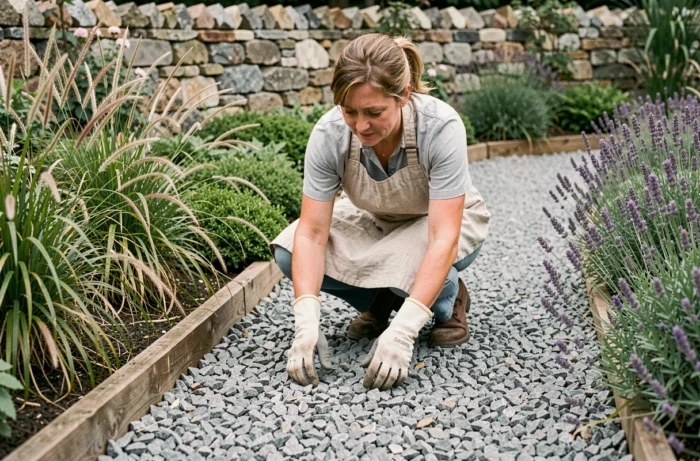
Gravel remains one of the most accessible materials for landscaping an outdoor space, but its actual price depends less on the stone itself than on everything surrounding it: transportation, packaging, distance from the quarry. The price differences between two seemingly identical purchases can double the final bill without the quality of the aggregate being in question.
Logistics and delivery: the real cost driver
Most online comparisons focus on the price per ton. The 2026 price lists place a ton of gravel between 20 and 70 euros depending on the region and type of stone. However, this figure doesn’t say much about the actual amount to be paid.
A big bag of 1 m³ delivered often reaches 100 to 180 euros including tax. The gap between the material price and the delivered price is explained by handling, fuel, and the distance between the depot and your site. For a modest-sized project (a pedestrian path, a flower bed border), these additional costs sometimes represent more than half of the budget.
Three levers can help reduce this extra cost without changing the type of gravel:
- Check truck access on your property. A semi-trailer that cannot maneuver requires a transfer to a smaller vehicle, which incurs additional charges.
- Combine your order with a neighbor or a friend to meet the minimum delivery requirements of the quarries (often set between 5 and 10 tons) and share transportation costs.
- Prefer a local supplier with its own trucks rather than an online marketplace, as the short circuit is often more competitive for bulk deliveries on site.
In other words, optimizing logistics saves more than negotiating a few euros off the ton price. Before looking for the cheapest gravel, it’s better to map out the quarries and suppliers located within a reasonable radius of your home. For buying cheap gravel for the garden, this logistical approach takes precedence over hunting for catalog prices.
Bulk, big bag, or sack: packaging changes the price per kilo
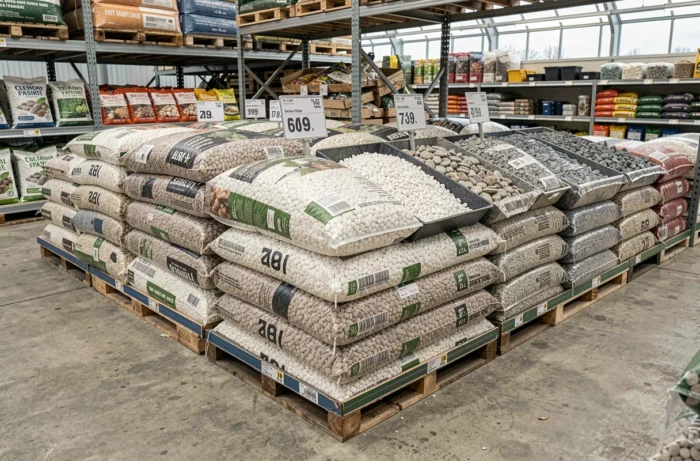
The choice of packaging is not trivial. Delivered bulk gravel typically ranges between 25 and 60 euros per ton depending on the region and the type of aggregate. In big bags, the same product costs significantly more due to packaging and pallets. In 25 kg bags sold at garden centers, the price per ton skyrockets.
Beyond about 30 m², bulk becomes almost systematically more economical. Below this area, bags remain interesting to avoid the minimum delivery requirements imposed by the quarries.
The classic trap is to buy a few big bags for an area that would justify a truckload of bulk. Do the reverse calculation: first estimate the necessary volume (desired thickness multiplied by the area), convert it to tons, and then compare the two formulas with delivery included. The result is often surprising.
Local limestone gravel or imported marble: origin matters as much as aesthetics
Crushed limestone gravel produced in a local quarry costs significantly less than white marble, quartz, or slate chips transported over several hundred kilometers. The type of rock determines the base price, but it’s the transportation distance that widens the gap.
For functional use (pedestrian path, around the house, flower bed base), regional crushed gravel fulfills the role perfectly. Crushed gravel also offers better stability than rolled gravel, making it suitable for high-traffic areas. For a driveway, a size of 6/14 or 10/14 in crushed or semi-crushed gravel can support the weight of vehicles without dispersing.
Decorative gravels (marble, slate, quartz) are justified on smaller surfaces where visual effect is paramount: planter, terrace border, dry garden. Mixing them with local gravel as a base layer helps limit the amount of noble material while maintaining the surface appearance.
Recycled aggregates: an underappreciated option for small budgets
Recycling platforms for rubble produce aggregates from deconstruction (crushed concrete, asphalt). These materials, processed and graded, generally cost less than natural aggregates extracted from quarries. Their use is growing in public works, but individuals also have access to them.
Field reports vary on this point: some recycled aggregates work very well as a sub-layer or in a driveway base, while others have a heterogeneous appearance that is less suitable for visible decorative use. Quality depends on the sorting platform and the type of original waste.
Before ordering, request a sample or visit the site. Local rubble and waste facilities or professional recycling centers sometimes offer recycled crushed material at reduced prices, with on-site pickup. Recycled aggregate is especially suitable as a sub-layer or driveway base, covered later with a finishing layer of natural gravel.
Common mistakes that derail the gravel budget
Underestimating the quantity remains the most common problem. An insufficient thickness (less than 5 cm for a pedestrian path) forces a quick reorder, with new delivery charges. It’s better to slightly overestimate from the first order.
Forgetting the geotextile is another costly mistake in the medium term. Without this fabric laid under the gravel, the stones gradually sink into the ground and weeds break through the surface. The geotextile extends the lifespan of the gravel by several years.
Buying on classified ad platforms without verifying the origin of the material exposes you to surprises: non-compliant grain size, presence of soil or debris, or even unprocessed demolition material. Reports of scams on this type of transaction are increasing on specialized forums.
Well-chosen, well-sized gravel delivered intelligently remains one of the most cost-effective outdoor improvements. The budget is managed in advance, not at the moment of clicking “order”.


