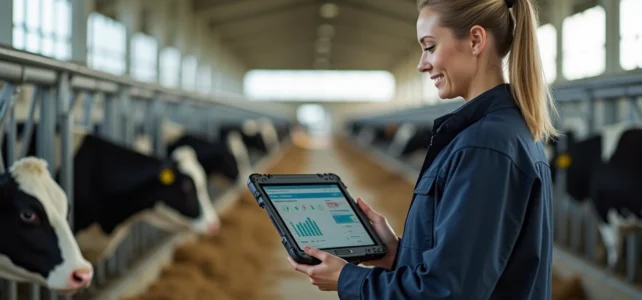
A calf that limps, a cow whose milk production drops for no apparent reason, a stock of feed that is depleting faster than expected: these signals sometimes go unnoticed when managing a herd on a daily basis. Digital tools dedicated to livestock farming change the game by making these alerts visible, measurable, and anticipatable. However, it is essential to understand what these solutions concretely bring, beyond the discussions about agricultural modernization.
When a sensor replaces the morning round
Before talking about software or artificial intelligence, we must return to the basic element: the sensor. An accelerometer attached to a cow’s collar continuously records its movements. An intravaginal thermometer tracks body temperature hour by hour. A GPS placed on an ear tag traces movements while grazing.
These sensors do not replace the farmer’s eye. They capture what the eye cannot see, especially at night or when the herd numbers in the hundreds. An abnormal behavior detected at 3 a.m. can trigger an alert on the farmer’s phone even before dawn.
A study by Idele (Institute of Livestock) indicates that in 2023, a beef cattle farm has an average of 2.3 connected devices, and the vast majority of beef farmers have at least one connected device on their farm. The movement is already well underway. Platforms like Aniwal contribute to this dynamic by offering digital services tailored to professionals in the animal sector.
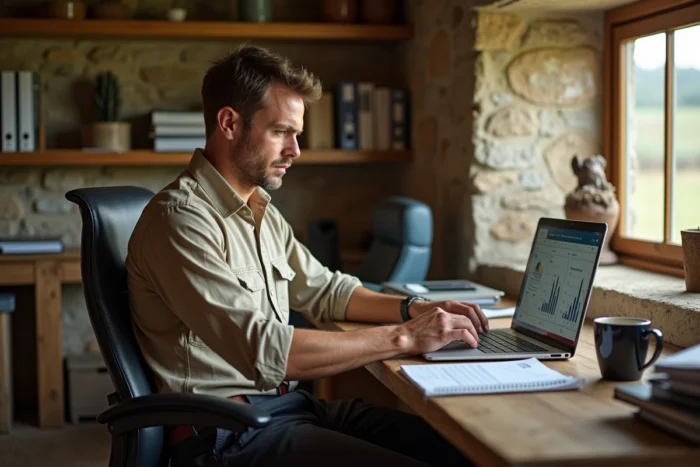
All-in-one livestock management tools: technique, accounting, and sales in the same interface
Have you ever juggled between a spreadsheet for births, a notebook for veterinary treatments, and another file for invoices? This compartmentalization of information wastes time and generates errors.
Recent solutions combine livestock monitoring, stock management, accounting, and even marketing into a single application. AGRI-X, for example, allows for recording production, mortality, feeding, expenses, and sales, then generating financial reports. FarmEase follows a similar logic with production tracking coupled with reports compliant with accounting standards.
Combining technical and financial data in the same tool avoids duplicate entries and reduces inconsistencies between records. For a farmer who also needs to declare animal movements or justify their health practices, this centralization simplifies administrative procedures.
What this convergence changes on a daily basis
- The feed cost per animal becomes readable in real-time, not just at the end of the campaign when it is too late to adjust.
- Stock alerts (feed, veterinary products) are triggered automatically, limiting supply shortages.
- The traceability of medication treatments is documented without additional effort, an asset in the face of increasing regulatory demands.
Early detection of health problems through artificial intelligence
Sensors collect data. Artificial intelligence interprets it. The combination of the two allows for identifying a health problem before clinical symptoms become visible.
Digitanimal, for example, combines geolocation and behavioral monitoring to anticipate reproduction or health problems in herds grazing extensively. AI identifies subtle variations in activity or rumination that would escape a one-time observation.
In cattle farming, respiratory diseases represent a telling use case. Research is focused on decision-support tools that combine sensor data and models to better reason treatment strategies. The goal is not to replace the veterinarian but to provide them with more precise information at the time of intervention.
Veterinary telemedicine and tele-mentoring
Veterinary telemedicine is progressing in parallel. Farmers located in areas where rural veterinarians are scarce can transmit their sensor data remotely. The veterinarian analyzes temperature or activity curves without traveling for an initial diagnosis.
Tele-mentoring goes further: a specialized veterinarian guides a general practitioner during a complex intervention, relying on the digital data of the herd. This model addresses a concrete issue of territorial coverage.
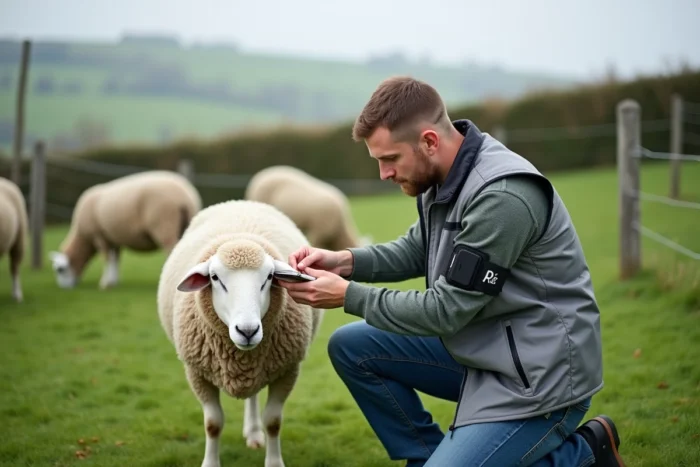
Training farmers in digital technologies: the real barrier to overcome
Having a high-performance sensor is useless if the farmer does not know how to interpret the alerts they receive. Why does this point deserve as much attention as the technology itself?
Because the actual adoption of a digital tool depends more on human support than on the cost of the equipment. Agricultural chambers offer training in digital farming. Some cooperatives include a training component in their sensor offerings. However, the pace of training often lags behind the pace of innovation.
- A trained farmer can distinguish a false alert from a real health signal, preventing unnecessary interventions.
- Mastering the all-in-one management tool allows for leveraging financial reports to negotiate with their bank or group.
- Understanding the limitations of algorithms protects against excessive reliance on automation.
The French government is investing in research linking agroecology and digital technology, which should ultimately strengthen the training offer tailored to sustainable farming practices.
Digital management of a farm is not just about installing sensors and waiting for the data to speak. The choice of tools, their integration into daily practices, and the ability to interpret alerts form a whole. Farmers who get the most out of these technologies are those who see them as a complement to their expertise, not as a substitute.