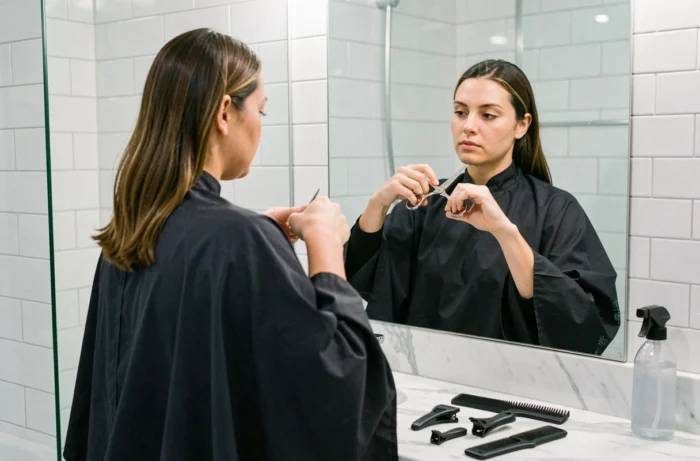
A botched haircut at home rarely results from a bad technique. It comes from a poorly chosen, poorly maintained, or poorly positioned tool. Successfully cutting your hair at home relies on technical fundamentals that most tutorials gloss over: blade quality, attack angle, and hygiene of the equipment between uses. Here, we detail the points that make the difference between a clean refresh and an obligatory trip to the hairdresser to fix the damage.
Blade, motor, and ergonomics: choosing a trimmer suitable for home cutting
The first selection criterion for a trimmer is not the brand, it’s the type of motor and the quality of the blade. A rotary motor provides consistent power on thick hair, while a pivot motor is sufficient for regular maintenance on fine hair. Linear motor models maintain a stable number of cuts per minute even when the battery weakens, preventing snagging at the end of the charge.
For blades, we recommend a steel-ceramic alloy: carbon steel cuts cleanly, while ceramic reduces heating. During a session longer than twenty minutes, a full-metal blade heats up to the point of becoming uncomfortable on the nape and temples.
The actual autonomy in continuous operation should take precedence over the displayed autonomy. A cordless device that lasts less than an hour on a full charge will force you to finish plugged in, with a cable that hinders wrist movement. Also test the weight distribution: a trimmer that is too heavy at the head tires the hand and degrades precision on the contours.
Before you start, consulting the latest trends on Blog Beauté allows you to visualize the result of different cuts and refine your choice of guard.
Hairdressing scissors and comb: the specifications that matter
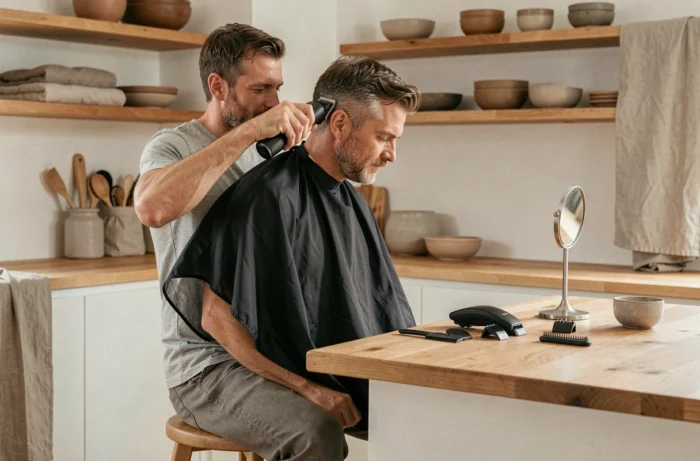
Kitchen or office scissors crush the hair fiber instead of cutting it. Hairdressing scissors have a convex blade sharpened between 40° and 50°, designed to glide over the strand without deforming it. It is this geometry that allows for vertical cutting to thin or horizontal cutting for clean ends.
The blade length determines the type of cut that can be achieved:
- Short blade (about 12 cm): ideal for finishing around the ears, short fades, and bangs. It offers maximum control over small sections.
- Standard blade (about 15 cm): versatile, suitable for shortening ends and straight cuts on medium to long hair.
- Sculpting scissors (with teeth): remove volume without shortening the apparent length. They are useful on thick or curly hair to lighten a cut without deconstructing it.
The tail comb (with a fine, pointed handle) is used to create precise separations. We observe that most fading errors come from approximate sectioning: without a clear separation, the guiding strand is contaminated by hair from the adjacent area, and the offset propagates throughout the head.
Hygiene of cutting equipment: beyond simple cleaning
Removing hair stuck between the blades after each use is a minimum, not a maintenance method. Article 118 of the Departmental Sanitary Regulation mandates the disinfection of instruments between each client for professionals, but the principle remains relevant at home as soon as multiple people share the same equipment.
Sanytol, household alcohol, consumer wipes: these products do not guarantee a sufficient biocidal spectrum on metal blades. According to Hygiène Plus, the critical point is the contact time. A disinfectant spray applied and wiped off immediately has no real effectiveness. The duration indicated by the disinfectant manufacturer must be respected, usually several minutes.
Mechanical maintenance also counts. Oiling the trimmer blades after each session extends their lifespan and preserves cutting sharpness. A drop of fine mineral oil on the blade rail, running the device for a few seconds to distribute the film, then wiping off the excess. Neglecting this step accelerates wear and increases pulling on the hair.
Men’s faded haircut technique with a trimmer: guards and transitions
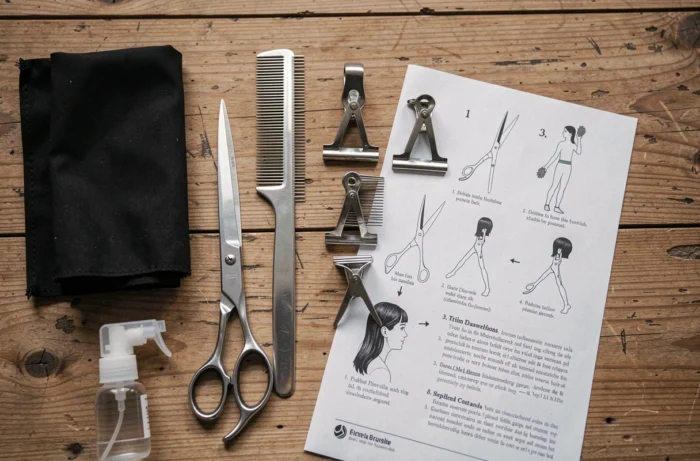
The fade relies on a logic of zones. The nape and temples receive the shortest guard, the middle zone an intermediate guard, and the top of the head remains longer (scissors or high guard). Each guard transition blends by tilting the trimmer at 45° outward on the demarcation line, never by laying the device flat.
The classic mistake is to go too high with the short guard. We recommend drawing an imaginary line connecting the top of the ears: this is the lower limit of the intermediate zone. Everything below accepts the short guard, everything above falls under the medium guard.
For a uniform buzz cut, a single guard is sufficient, but the pass must be made in several directions (against the grain, then across) to avoid shadow areas where longer hairs remain. On curly hair, working strand by strand with a comb that lifts the curl before cutting gives a much more even result than a flat pass.
Posture and lighting errors that sabotage the cut
Cutting hair in a poorly lit bathroom with only one wall mirror means working blindly on the entire back area. A triptych mirror or a second mirror placed opposite the first is a prerequisite, not an accessory. Lighting should come from the front and slightly above to avoid cast shadows that mask length differences.
Posture affects precision. Arms raised above the head for ten minutes, shoulder muscles tire and the hand trembles. Alternating sides, taking breaks, and especially not trying to finalize everything in one session significantly reduces the risk of asymmetry.
One last often-overlooked point: check the result on dry hair. Wet hair appears longer, and a fade that seems perfect on damp hair can reveal irregularities once dry. This intermediate check, with hair at least partially dried, saves you from touch-up retouches.


