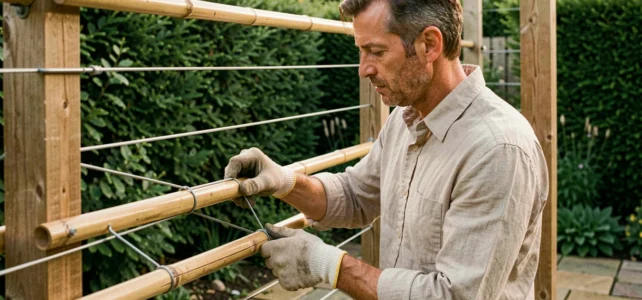
Making your own bamboo screen involves choosing the right type of cane, the right assembly, and the right surface treatment. These three parameters determine the lifespan of the panel as well as its visual appeal. Comparing options before cutting the first cane avoids costly mistakes in time and materials.
Running or Clumping Bamboo: What Impact on Harvested Canes
The distinction between Phyllostachys (running) and Fargesia (clumping) is not just about planting in a living hedge. It also determines the diameter and rigidity of the canes available for a panel.
Phyllostachys produces large-diameter, rigid canes suitable for a self-supporting structure. In contrast, Fargesia offers thinner and more flexible canes, better suited for tight weaving or filling between posts.
| Criterion | Phyllostachys (running) | Fargesia (clumping) |
|---|---|---|
| Diameter of canes | Medium to large | Thin to medium |
| Rigidity | High | Moderate, flexible |
| DIY screen use | Structural panels, fences | Weaving, dense filling |
| Rhizome constraint | Anti-rhizome barrier required | None |
| Useful growth | Fast, canes usable in a few seasons | Slower, shorter canes |
If you harvest your own bamboo, a Phyllostachys planted with an anti-rhizome barrier will provide usable canes more quickly. Fargesia, on the other hand, is better when you want to combine a living hedge and filling panels along the same line.
When looking to create a bamboo screen with canes purchased from a garden center or salvaged, checking the species of origin allows you to anticipate the material’s behavior once dry.
Assembly of Bamboo Canes: Steel Wire, Screws, or Natural Binding
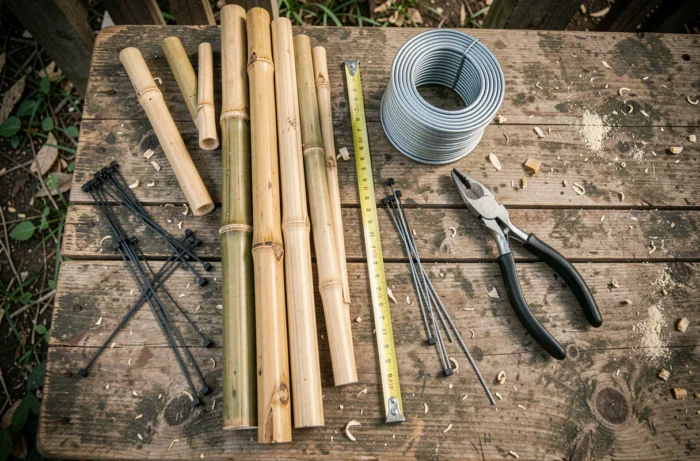
The assembly method determines both the strength of the panel and its resistance to wind. Three techniques dominate DIY construction projects.
- The galvanized steel wire twisted between each cane replicates the method used for commercial reed screens. It withstands the elements well and maintains a consistent spacing between the canes.
- Screwing onto two horizontal wooden battens (strips or half-rounds) is suitable for larger diameter canes. Pre-drilling avoids splitting the bamboo, which easily shatters under direct pressure.
- Natural binding with hemp or jute rope gives a more artisanal look. It requires replacement every two to three years outdoors, unless a protective varnish is applied to the knots.
Pre-drilling is the most overlooked precaution in quick tutorials. Without it, the screw splits the cane along its entire length, and the panel loses its rigidity at the first gust.
For a fence panel exposed to the wind, the combination of steel wire plus two screwed battens offers the best compromise. Binding alone is suitable for balconies or sheltered terraces.
Spacing and Screening
The closer the canes are spaced, the stronger the screening effect, but wind resistance also increases. A spacing of a few millimeters between each cane allows a stream of air to pass through, reducing mechanical stress on the fastenings.
On a property boundary installation, check local regulations and condominium rules before fixing the final height. Several municipalities impose restrictions on the height and type of screen allowed.
Protection and Treatment of Bamboo Outdoors
Untreated bamboo grays within a season and can crack due to moisture-dryness cycles. Two approaches extend its durability.
The first involves applying an outdoor wood oil (such as linseed oil or special teak oil) after light sanding. The oil penetrates the fibers and limits water absorption without forming a surface film. It should be reapplied every year or every two years depending on exposure.
The second option is a saturator or marine varnish, which creates a more durable barrier. Varnish requires complete sanding before each new layer, complicating maintenance on round canes.
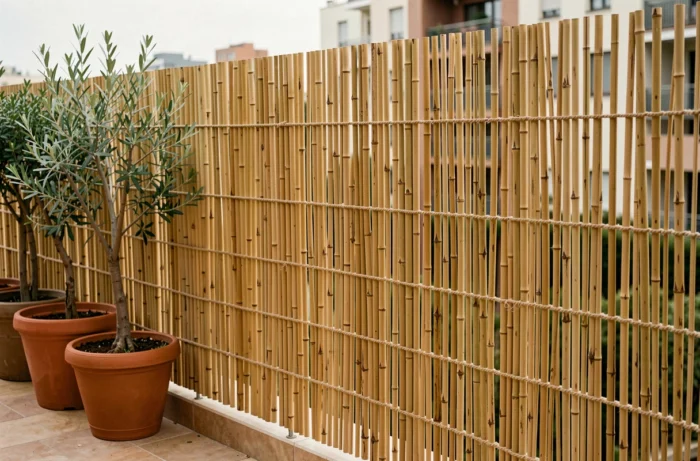
Seasonal Maintenance of Bamboo Screens
A cleaning with clear water and a soft brush at the beginning of spring is enough to remove moss and deposits. Fungicidal treatments are only useful if black stains persist after brushing.
A yearly oiled bamboo retains its golden hue much longer than untreated bamboo. Graying does not affect strength, but it significantly alters the garden’s aesthetic.
Bamboo Screen in a Planter: Solution for Balconies and Small Terraces
On a balcony or terrace where it is not possible to fix posts to the ground, a tall planter with integrated trellis offers an alternative. A Fargesia in a large container is planted, which forms a dense green screen from the first season if the plant is already developed.
Recent guides emphasize one point: starting from a large potted plant closes the hedge much faster than a small specimen. Fargesia supports container cultivation as long as the soil remains cool, rich, and well-drained. During hot periods, watering must be regular, as this bamboo quickly suffers from drought.
You can also combine a dry bamboo panel fixed to the railing with a planter of climbers (star jasmine, clematis) for a mixed screen. This approach is suitable for small areas where a linear plant fence would be disproportionate.
The choice between a manufactured panel and a living hedge ultimately depends on the time available for maintenance. A panel of assembled canes requires only annual oiling. A Fargesia hedge requires regular watering and shaping pruning at the end of summer. Both options provide privacy, but they do not engage the same gardening schedule.