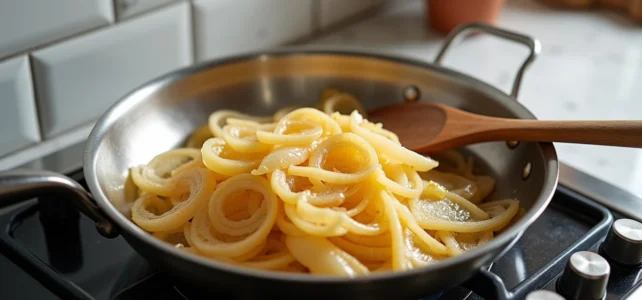
Sautéing onions without fat in a classic steel or stainless steel pan is a technical challenge. The non-stick coating changes the game, but it doesn’t solve everything: without careful management of temperature and deglazing liquid, the onions burn or remain raw in the center. Here, we detail the parameters that really matter.
Choosing the Pan Material for Fat-Free Cooking
A bare stainless steel or unseasoned cast iron pan sticks to the onions as soon as the sugars begin to caramelize. Without a lipid film to buffer between the metal and the onion’s cell walls, the Maillard reaction turns into localized carbonization.
The non-stick coating is almost mandatory for this technique. Recent ceramic or PTFE pans offer sufficient glide as long as the coating is intact. A scratched or worn bottom becomes a sticking surface again, negating the benefit.
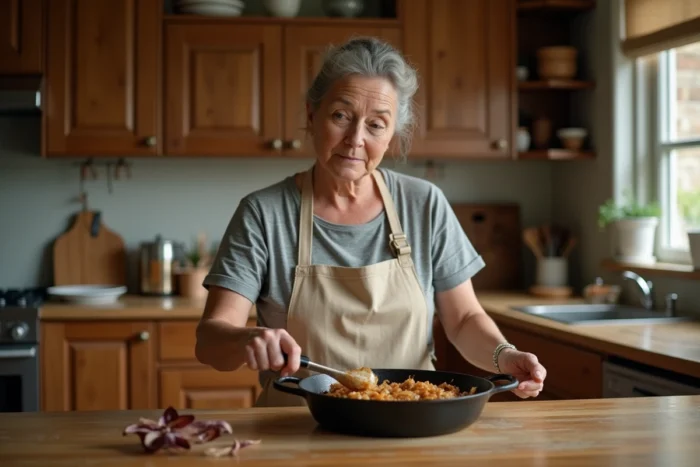
Enameled cast iron is an alternative: the smooth enamel limits adhesion, and the thermal mass of cast iron better regulates temperature spikes. We recommend preheating the enameled cast iron on low heat for several minutes before adding the onions. Note that the technique of sautéing onions in a pan without fat relies as much on the choice of equipment as on the technique.
For stainless steel pans, a temporary seasoning with water (the rolling drop test method) helps create a thin steam barrier, but this trick requires constant temperature control.
Temperature and Management of Deglazing Liquid
Fat-free cooking requires moderate heat, never high. Oil absorbs and redistributes heat evenly. Without it, the areas of direct contact between the onion and the metal receive all the thermal energy, creating burn spots in just a few seconds on high heat.
We find that the optimal setting is below medium heat on most induction cooktops. On gas, the flame should never exceed the diameter of the pan’s bottom.
Sequential Deglazing Rather Than Initial Wetting
A common mistake is pouring water into the pan right from the start. The result: the onions poach instead of sautéing. The bottom of the pan remains saturated with moisture, and no browning occurs.
The right approach is sequential deglazing: place the sliced onions in the dry pan, let the thermal contact initiate slight browning, then add one to two tablespoons of water (or broth) only when the onions start to stick. This liquid lifts the fond, redistributes flavors, and restarts the cooking. Repeat this process as many times as necessary.
This method resembles the principle used in plant-based cooking to caramelize onions intended for a sauce or broth. A splash of white wine or balsamic vinegar can also be used as a deglazing liquid, adding an interesting acidity at the end of cooking.
- First phase (3-4 minutes): dry pan, moderate heat, thinly sliced onions placed in a single layer, without stirring for the first minute.
- Second phase: as soon as the onions stick slightly to the bottom, pour in a tablespoon of water and scrape with a wooden spatula.
- Subsequent phases: repeat deglazing at each point of sticking, spacing out the additions to allow evaporation to do its job.
Cut Thickness and Water Content of Onions
A parameter often overlooked in mainstream recipes: the thickness of the slices determines the success of fat-free cooking. Thick slices release their water too slowly, creating an extended poaching phase before any browning occurs. Slices that are too thin carbonize before they have time to melt.
We recommend a thickness of between two and three millimeters for a standard yellow onion. Finely diced (small cubes) also works, but the contact surface with the pan is then reduced, limiting caramelization.
Onion Variety and Final Result
The classic yellow onion remains the most suitable. Its sugar content allows for natural caramelization even without fat. The red onion colors more but contains more anthocyanins that brown in a less predictable manner.
The white onion, which is more watery, releases a lot of water at the beginning of cooking. This means extending the evaporation phase before browning can begin, which lengthens the total time.
The spring onion (young onion) poses a specific problem: its very high water content makes dry cooking difficult. It’s better reserved for preparations where it will be added at the end rather than as a base for cooking.
Technical Mistakes That Cause Fat-Free Cooking to Fail
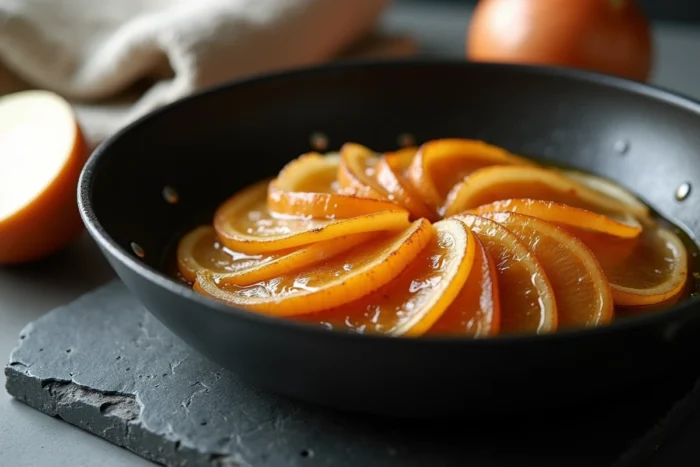
Overloading the pan is the primary cause of failure. When the onions overlap, they collectively release their water and create a steam bath. The surface temperature drops, the Maillard reaction doesn’t start, and you end up with soft, pale onions.
- Never fill the pan beyond a single layer of onions, even if it means cooking in two batches.
- Do not cover the pan: the lid traps steam and prevents evaporation, turning the cooking into steaming.
- Avoid constant stirring. Allow the onions to stay in contact with the bottom for at least a minute before each movement to initiate browning.
Salt, often added by reflex, accelerates water release by osmosis. Salting at the very end of cooking preserves texture and allows caramelization to occur properly.
Fat-free cooking is not simply a matter of replacing oil with emptiness. It is a technical protocol that combines the right pan material, controlled heat, sequential deglazing, and cutting suited to the onion variety. Every variable counts, and it is their combination that determines whether the onions will be golden and tender or burnt and stuck to the bottom.