
Barilla pesto is among the most common sauces found in French cupboards. During pregnancy, its composition raises legitimate questions that go beyond the simple reflex of “industrial = safe.” Between the nature of the ingredients, the storage conditions, and the nutritional profile of the product, several points deserve careful examination.
Nuts in Barilla pesto: a digestive angle often overlooked
Articles discussing pesto during pregnancy focus almost exclusively on the bacteriological risk (listeria, toxoplasmosis, salmonella). One aspect that goes unnoticed is the presence of nuts such as pine nuts or cashews in several Barilla references.
These nuts can exacerbate heartburn, nausea, and digestive discomfort, especially in the third trimester when gastroesophageal reflux becomes common. The issue is not a strict allergy (which remains rare), but rather individual digestive tolerance.
Pregnant women with a family history of allergies or a history of reflux would benefit from reading the ingredient list before opening the jar. Nuts are not contraindicated during pregnancy, but their irritating effect on an already challenged digestive system remains under-documented in mainstream dietary guides. To delve deeper into the precautions related to Barilla pesto and pregnancy, several resources detail the interactions between ingredients and trimesters.
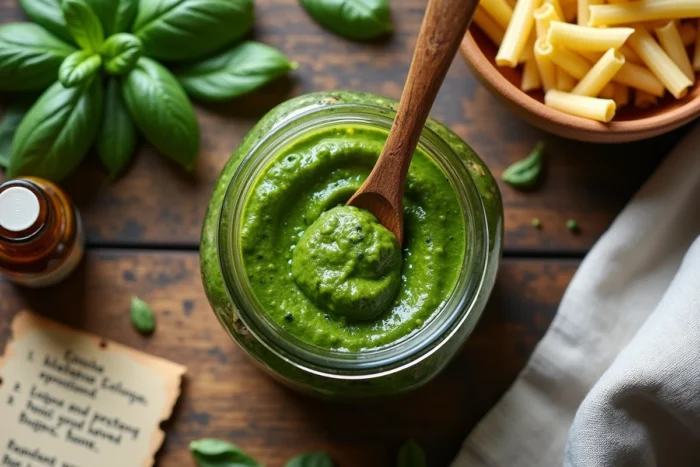
Bacteriological risk of industrial pesto versus homemade
Barilla pesto, like most non-refrigerated jarred pestos, undergoes a thermal treatment during its production. This process significantly reduces the bacterial load, distinguishing it from fresh pesto prepared in the deli section or at home.
Sterilized jarred pesto
An unopened industrial pesto stored at room temperature presents a very low microbiological risk. Sterilization eliminates common pathogens. The problem begins after opening: the product must be consumed quickly and stored in the refrigerator.
Fresh or homemade pesto
Pesto made with unwashed fresh basil, raw milk parmesan, or bulk pine nuts exposes one to different risks. Fresh basil may carry soil residues (a vector for toxoplasmosis), and poorly aged raw milk cheese can harbor Listeria monocytogenes.
The distinction to remember:
- A closed, unexpired jar of Barilla pesto does not pose a bacteriological problem comparable to that of a homemade sauce based on raw ingredients
- After opening, the refrigeration period should not exceed a few days, even if the product appears visually intact
- Pesto from the fresh section (in refrigerated packaging) follows an intermediate logic: pasteurized but with a shorter shelf life than the jar
Salt, fats, and gestational diabetes: the nutritional profile in question
The infectious risk captures all the attention, but the nutritional profile of pesto deserves equal vigilance for women monitored for complications. Industrial pestos, including Barilla, contain a notable amount of salt and fat per serving.
For a pregnant woman with gestational hypertension or diabetes, this sodium and lipid load is not negligible. A tablespoon of pesto may seem harmless, but the accumulation over a pasta meal (generous sauce, grated parmesan on top, bread on the side) can tip the balance.
Women monitored for gestational diabetes should watch the overall meal load, not just the safety of each ingredient taken in isolation. Pesto is not a “forbidden” food, but it fits into a nutritional context that goes beyond the bacterial question.
Rosso pesto versus classic pesto during pregnancy
The Barilla range offers pesto alla genovese (green, with basil) and pesto rosso (red, with sun-dried tomatoes). Both variants share a similar base (olive oil, cheese, nuts), but differ in one aspect: the pesto rosso contains sun-dried tomatoes that increase the acidity of the product.
For women prone to acid reflux, common from the second trimester, pesto rosso may exacerbate discomfort. On the other hand, sun-dried tomatoes provide lycopene, an antioxidant whose bioavailability is better after thermal processing.
This is not a binary choice between “good” and “bad.” The selection criterion is more about individual digestive tolerance than a nutritional superiority of one variant over the other.
Practical precautions for consuming Barilla pesto during pregnancy
Some practical guidelines allow for consuming this sauce without unnecessary anxiety:
- Check the expiration date and the integrity of the jar before opening (bulging lid = throw away)
- After opening, close immediately, store in the refrigerator, and consume within three to four days
- Systematically read the ingredient list to spot allergens (nuts, milk, gluten depending on the recipes)
- Adjust the quantity to the medical context: in case of gestational diabetes or hypertension, limit the portion and compensate with green vegetables
Barilla pesto remains a condiment, not a main dish. Used in reasonable quantities, on whole pasta accompanied by vegetables, it can easily fit into the diet of a pregnant woman without particular risk factors. The available data do not allow it to be classified among foods to be banned, provided that basic storage rules are followed and one considers their own digestive and metabolic background.