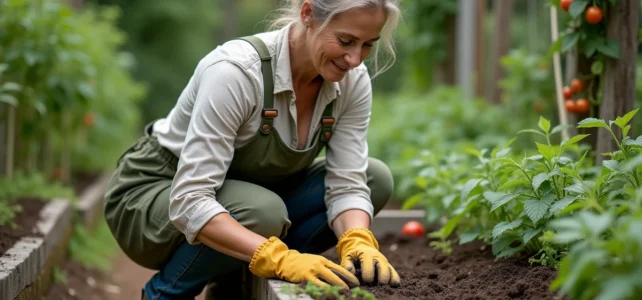
Your tomatoes have yellow leaves, your salads are disappearing under slugs, and the soil in your vegetable garden looks like concrete after every rain. These problems rarely have a single cause, but they often share the same origin: soil that has been mistreated by years of deep tilling and chemical treatments. Ecological gardening offers a different approach, focused on soil biology and the choice of appropriate tools to cultivate a naturally productive vegetable garden.
Drought-resistant varieties: the lever that gardeners overlook
Have you ever noticed that some tomatoes survive without watering during a week of heatwave, while others wilt in two days? The difference is less about your watering technique and more about the variety planted.
Since the widespread implementation of prefectural water restriction orders in the summer, variety selection has become a cornerstone of ecological gardening. Mulching and installing drip irrigation are no longer sufficient if the plant itself requires a lot of water.
Old and local varieties, selected before the era of systematic irrigation, often have deeper root systems. They seek moisture deep down. Specifically, an old “beef heart” type tomato or a Provence musky squash tolerates dry periods much better than an F1 hybrid created for cultivation under irrigated greenhouses.
To find varieties suited to your soil and climate, specialized resources like grelinette-warrior.com allow you to cross-reference hardiness criteria with soil type.
Three simple criteria for choosing a water-efficient variety:
- Favor seeds from local or peasant selections, adapted to your region’s conditions for several generations.
- Check the root depth mentioned on the variety sheet: the deeper the root goes, the less the plant depends on surface watering.
- Avoid F1 hybrids for the most exposed summer crops (tomatoes, zucchinis, beans) if you are in an area subject to recurring water restrictions.
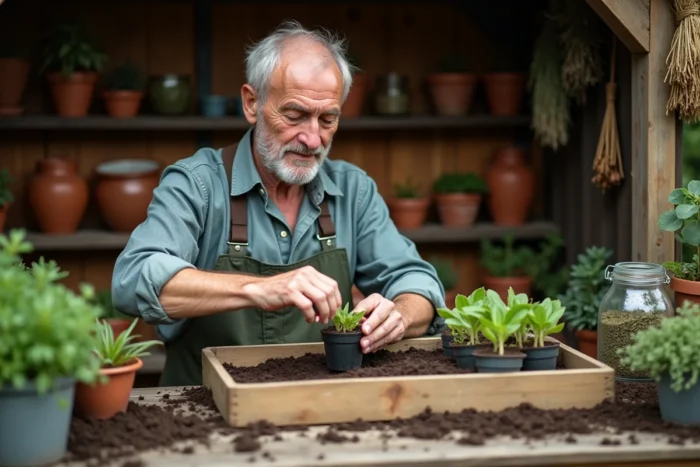
Grelinette and shallow soil working tools in the vegetable garden
Turning the soil with a spade is a gesture that most gardeners have learned. The problem is that this tilling destroys the biological structure of the soil. Earthworms, mycorrhizal fungi, and bacteria that nourish your plants live in the top few centimeters. Burying them thirty centimeters deep kills or disorganizes them.
The grelinette aerates the soil without turning it over. The tines penetrate deeply, and the rocking motion lifts and cracks the soil. The underground life remains intact. After a few seasons, the soil becomes softer, easier to work with, and retains water better.
Choosing between grelinette, fork-spade, and rake
The grelinette (with four or five tines) is suitable for established growing beds. Its weight and width allow you to prepare an entire bed in just a few minutes, without straining your back.
The fork-spade remains useful for small areas or very compact soils in the first year. It allows you to break clumps without turning the soil horizons.
The rake (or claw) is used after the grelinette to refine the surface before sowing. It breaks up the last clumps and levels the seedbed. A combination of grelinette, fork-spade, and rake effectively replaces a tiller, without consuming energy and without destroying soil fauna.
Permanent mulching and compost: feeding the soil rather than the plant
In ecological gardening, you do not feed the plant directly with soluble fertilizer. You feed the soil, which nourishes the plant. This distinction changes everything.
Permanent mulching acts as a living cover. It protects the soil from the sun (less evaporation), slows down weeds, and decomposes slowly into humus. A permanently mulched soil maintains stable moisture even in the height of summer.
What mulch for what use in the vegetable garden
Not all mulches are created equal. Their choice depends on what you are growing and the season:
- Wheat or barley straw is suitable for summer crops (tomatoes, squashes). It decomposes slowly and does not create nitrogen hunger.
- Grass clippings, spread in a thin layer, provide nitrogen quickly. They are suitable around salads and leafy vegetables, provided they do not exceed a few centimeters in thickness to avoid fermentation.
- Wood chips (BRF) are used in autumn and winter on empty beds. They nourish soil fungi and improve structure in the long term, but they mobilize nitrogen as they decompose, making them unsuitable at the beginning of the growing season.
- Dead leaves, free and abundant, make an effective winter mulch to protect the soil from frost and compaction.
Compost, on the other hand, is worked on the surface. Spread in a layer of a few centimeters on the soil in autumn or spring, it revives biological activity without tilling. The combination of permanent mulching and compost application twice a year is enough to maintain fertile soil without any chemical fertilizers.
Beneficial insects and biodiversity: letting natural predators do the work
An ecological vegetable garden does not seek to eliminate all pests. It aims for a balance where natural predators regulate pest populations. To establish this balance, you need to provide them with a habitat.
Ground beetles, those black beetles that run between the rows of vegetables, devour slugs and pest eggs at night. They need refuge areas: a pile of stones, a strip of tall grass at the edge of the garden, a thick mulch to hide under during the day.
Syrphid flies, those small flies that resemble wasps, lay their larvae directly on aphid colonies. A flowering border with yarrow, phacelia, or fennel attracts adult syrphids that come to feed on nectar and stay to lay eggs in the garden.
Installing an insect hotel can help as a supplement, but without flowers or wild areas nearby, it will remain empty. Natural habitat takes precedence over equipment.
The most disease- and pest-resistant vegetable garden is not the one that uses the best treatments, even organic. It is the one where the soil is alive, the varieties are suited to the local climate, and the biodiversity is rich enough for every imbalance to correct itself. An ecological vegetable garden requires fewer interventions over the years, not more.