
Real estate work refers to all interventions on a building, from the structural work (structure, roof, foundations) to the finishing work (insulation, electricity, coverings). Their success relies less on the choice of materials than on the management method of the site, the traceability of exchanges, and the ability to react to unforeseen events before they become disputes.
Remote site management: real constraints and monitoring methods
Managing a renovation without being physically present is a common situation, especially for owners of rental properties located in another city. The main difficulty is not technical: it lies in the lack of daily visual control over progress.
Without regular visits, deviations from the plans go unnoticed for weeks. A partition misaligned by a few centimeters, an electrical outlet forgotten, a covering installed before the complete drying of a screed: these defects can only be seen on-site, rarely in a photo sent by the contractor.
The solution relies on three complementary measures:
- A contradictory progress report, drafted at each key stage (end of demolition, end of structural work, before finishing installations), signed by the project manager and the company. This dated document serves as proof in case of subsequent disagreement.
- A weekly site report, even brief, sent in writing (email or dedicated management tool). Oral exchanges or instant messaging are legally worthless without a timestamped record.
- A physical visit (by the owner or a designated third party) at moments of irreversible decisions, particularly before closing the partitions and during the acceptance of the work.
To delve deeper into the subject and compare the types of possible interventions, the work on Alias Immo details the major categories of construction sites according to their scope and purpose.
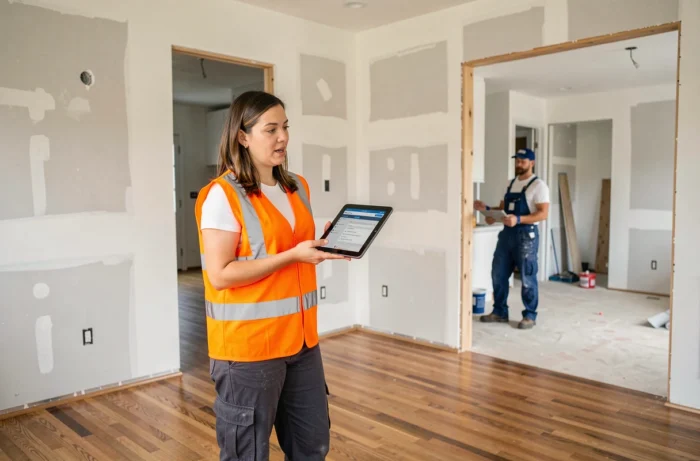
Acceptance of work and reservations: the moment everything is at stake
The acceptance of work is a precise legal act, not just a courtesy visit. It marks the transfer of responsibility: before acceptance, the company assumes the risks on the work; after, it is the owner who is responsible, subject to legal guarantees.
In practice, the owner (or their representative) inspects each batch of work and records the defects noted in a reception report. These defects, called reservations, obligate the company to correct them within an agreed timeframe.
Remote reservations: an underestimated risk
When the owner is not on-site on the day of acceptance, two common mistakes occur. The first: signing the report without reservations, out of trust or fatigue, which makes any subsequent claim very difficult. The second: delegating the acceptance to someone who does not know the initial specifications and therefore does not identify the discrepancies.
Any reservation not formulated at the time of acceptance is presumed accepted. The only exception concerns hidden defects, reported within a limited timeframe after acceptance. For an absent owner, appointing a project manager or architect for this specific step remains the most reliable solution.
Renovation schedule and budget: anticipating frequent overruns
A construction schedule is not a fixed calendar. It is a coordination tool between trades, where any delay on one batch (plumbing, electricity, carpentry) mechanically pushes back the following ones.
The most common overrun comes from an incomplete initial diagnosis. Discovering a moisture problem in the walls after starting insulation, for example, requires revisiting the structural work before continuing, resulting in additional costs and cascading delays.
What the budget must account for from the start
A realistic renovation budget includes a margin for unforeseen events, usually expressed as a percentage of the total cost of the work. This margin covers discoveries during the project (old pipes, undetected asbestos in the diagnosis, degraded load-bearing floors).
Three items are consistently underestimated:
- The electrical upgrades, often more extensive than expected in older buildings.
- The treatment of interfaces between batches (connections between new and existing plumbing, junctions between insulation and carpentry).
- The fees for project management or coordination, which many owners choose to eliminate to reduce the budget, at the cost of degraded oversight.

Written proof and dispute management in real estate renovation
The professionalization of site management involves a simple reflex: every commitment must exist in writing before the start of the work. Signed detailed estimates, provisional schedules, payment conditions staggered according to actual progress (and not elapsed time).
In case of poor workmanship or abandonment of the site, the formal first step remains the formal notice by registered letter. It must precisely mention the noted defects, the timeframe granted to remedy them, and reference the signed estimate or contract.
Online site management tools now allow for automatic timestamping of exchanges, photos, and step validations. A structured digital history significantly simplifies the resolution of disputes, whether amicably or in court.
The key point for any owner, present or not on the site: the quality of a renovation is measured as much by the documentary rigor as by the technical competence of the craftsmen. A well-constructed site but poorly documented exposes the same risks as a poorly executed site.