
In freezing weather, a fleece worn over a technical t-shirt dries in less than an hour after a downpour. A cashmere sweater, on the other hand, can take an entire day to return to its normal state. This detail changes everything when choosing your warm layer for winter, because the warmth of a fabric is not just about its raw insulating power.
Microfibers in washing: the criterion that labels don’t show
Before even talking about warmth or softness, one point deserves attention: fleece, even labeled “recycled,” remains polyester. Recycled polyester retains the same chemical nature as virgin polyester. It continues to release plastic microfibers into the wash water, cycle after cycle.
For a fleece worn often while hiking or in the city, limiting washes and using short cycles significantly reduces fiber emissions. Properly filling the drum also helps, according to research by Kelly et al. published in 2019 in Environmental Science & Technology. Cashmere is also subject to maintenance constraints, but its animal fibers degrade in the environment, where polyester persists.
There is also a comparison of fleece and cashmere according to Rev Mode that details the differences in insulation and breathability between these two materials, without always addressing this environmental angle.
Thermal insulation of fleece and cashmere: what happens in the fiber

Cashmere comes from the down of goats raised in regions with harsh winters. Its ultra-fine fibers trap air in a very dense structure, giving it superior insulating power compared to many synthetic fibers despite its lightness.
Fleece works differently. Its synthetic fibers are brushed to create an airy texture that retains warm air against the skin. Fleece excels in breathability and dries quickly, but it offers less protection from the wind than tightly woven cashmere. As soon as a gust passes through the fabric, the feeling of cold returns more quickly with an unlined fleece.
When layered under a windbreaker, fleece regains the advantage: it wicks moisture outward and retains its insulating power even when wet. Cashmere loses some of its warmth when it absorbs moisture, making it less suitable for prolonged physical exertion in humid conditions.
Traceability of cashmere: a requirement that changes the game in 2025
Cheap cashmere has flooded the market for years, often without reliable information on the origin of the fiber. The Sustainable Fibre Alliance published version 1.0 of its standard in December 2024, applicable from April 1, 2025. This reference replaces the old cashmere-specific standard and strengthens traceability requirements.
In practical terms, checking the certification and origin of the fiber becomes more relevant than choosing based on thickness or price. SFA-certified cashmere guarantees a minimum level of control over breeding conditions and the quality of the down. Cashmere without traceability, sold at a bargain price, may contain a mix of fibers of highly variable quality.
For fleece, traceability mainly concerns recycled polyester. The label “recycled” is not enough: it is necessary to check if the product meets a recognized standard (GRS, for example) to ensure that the recycling is real and documented.
What European regulation is preparing
Textile clothing is gradually coming under the European regulation on ecodesign (ESPR). Ultimately, a digital product passport could become mandatory, with data on composition, durability, and reparability. Feedback varies on the precise timeline for implementation, but the direction is clear: opacity regarding raw materials is set to disappear.
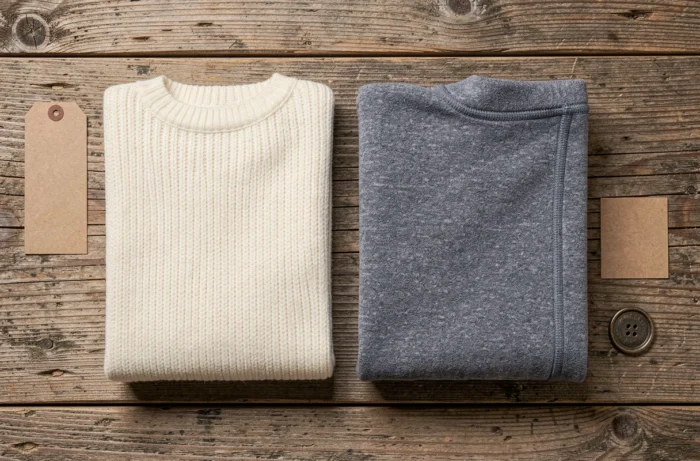
Fleece or cashmere depending on use: quick choice table
Rather than declaring a universal winner, it’s more efficient to reason by situation. Here are the cases where each material excels:
- Hiking, cross-country skiing, winter biking: fleece dries quickly, breathes well, and withstands frequent washes without deforming. It remains the reference for activities in motion.
- Office, city outings, daily commutes: cashmere offers superior warmth for less weight, with a more dressed appearance. A thin sweater is often enough under a coat.
- Severe dry cold and static conditions (Christmas market, waiting outdoors): cashmere insulates better when not moving, provided it is protected from the wind with an outer layer.
- Humid conditions or light rain: fleece retains its insulating properties even when wet, unlike cashmere, which takes a long time to dry and loses thermal efficiency.
| Criterion | Fleece | Cashmere |
|---|---|---|
| Windless insulation | Good | Very good |
| Wind resistance | Low (without membrane) | Medium to good |
| Drying | Fast | Slow |
| Care | Machine, low maintenance | Delicate, hand wash recommended |
| Microfiber impact | High (plastic) | Low (biodegradable animal fiber) |
| Average price | Accessible | High |
Winter maintenance: extending the lifespan of each material
A well-maintained fleece retains its insulating properties for several seasons. It should be washed at low temperatures, without fabric softener (which clogs the fibers and reduces breathability). A low-temperature tumble dryer is tolerated, but air drying is preferred.
Cashmere requires more attention. A hand wash in lukewarm water with a mild shampoo preserves the flexibility of the fibers. The spin should be done flat, never twisting the garment. Between washes, airing out the sweater overnight is often enough to eliminate light odors.
- Fleece: wash inside out, short cycle, no fabric softener, air dry
- Cashmere: hand wash or very gentle wool cycle, flat drying, folded storage (never on a hanger)
- For both: space out washes as much as possible to preserve fibers and limit wear
The choice between fleece and cashmere is not settled on a podium. It is made in front of your closet, depending on the day ahead: movement or stillness, rain or dry cold, office or trail. Having both remains the most effective strategy to cover an entire winter without compromise.


