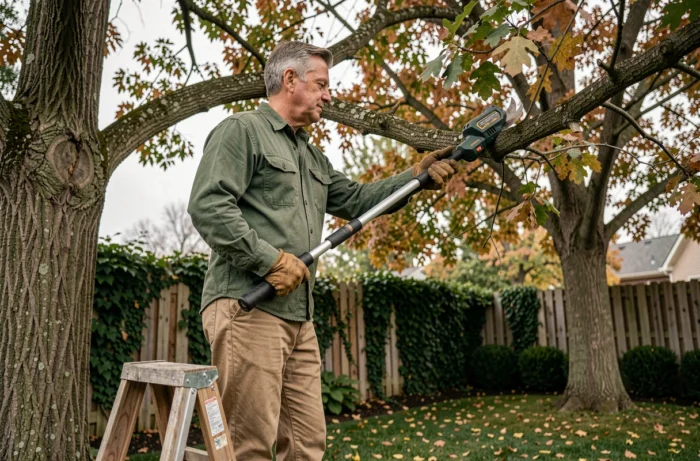
A poorly sized pruner tires the operator, damages the wood, and increases the risk of kickback. Choosing the right model depends on three specific technical parameters: the actual cutting diameter, the weight-to-power ratio, and the working environment, particularly the proximity to overhead networks or public roads.
Chain, guide, and pitch: the specifications that determine cutting
The guide bar determines the maximum branch diameter that the pruner can tackle in one pass. A short guide offers more maneuverability in dense crowns, while a long guide is suitable for thick branches but adds weight to the overall tool and complicates one-handed operation.
We recommend cross-referencing two data points before any purchase: the guide length and the chain pitch. A fine pitch produces a clean cut with less vibration, suitable for formative pruning on fruit trees. A wider pitch better expels chips on hardwood or softwood but puts more strain on the motor.
The chain tension also deserves attention. Tool-less tensioning systems, present on most recent models, allow for quick height adjustments without coming down. A loose chain increases the risk of derailment, a particularly dangerous situation when using a pole several meters off the ground. The catalogs available on elagueuse-warrior.com detail these characteristics for each reference, making technical comparison easier before purchase.
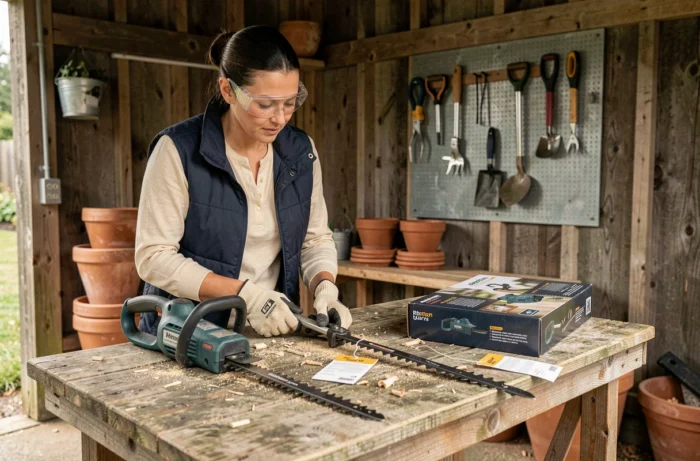
Gas or battery pruner: decide based on project duration
The gas engine remains the standard for extended projects where autonomy matters more than acoustic comfort. Its displacement directly affects the available torque and the ability to maintain chain speed under load in green wood.
The battery has caught up with gas for common pruning uses, including in professional settings. Instant starting, no carburetor maintenance, and reduced vibrations transmitted to the hands are concrete advantages during a repetitive workday.
However, the battery requires planning for pack rotations. On a light pruning project spread over several hours, having at least two high-capacity batteries avoids downtime. The weight of the battery, often mounted on the back or belt on professional models, alters the overall balance of the machine.
Pole pruner: a special case
The pole pruner allows work from the ground on branches located high up. This is a major safety advantage as it eliminates the need for a ladder for routine clearance cuts.
The trade-off lies in the weight at the end of the pole. The longer the pole, the more torque is needed to keep the tool in position. A lightweight telescopic pole with a short guide remains the best compromise for an individual who prunes a few times a year on medium-sized trees.
Safety and regulations: often ignored constraints
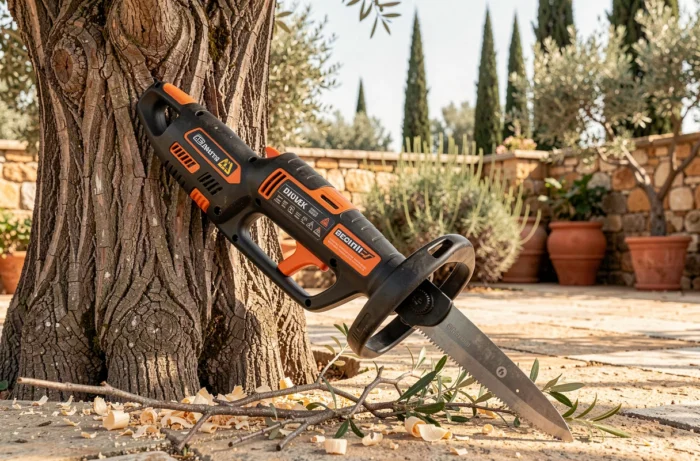
The use of a top handle pruner is reserved for work at height. In France, the use of this type of machine on the ground is prohibited, a rule that many individuals are unaware of. For ground cuts, one must turn to a traditional two-handed chainsaw.
Wearing personal protective equipment is not just a recommendation. In a professional context, the employer is obliged to provide PPE free of charge, maintain it, and train operators on its use. For an individual, the logic remains the same:
- Helmet with mesh visor and integrated ear protection to guard against debris and engine noise
- Cut-resistant gloves with protection on the back of the left hand (dominant hand on the front handle)
- Chaps or cut-resistant pants of the appropriate class for the type of chain used
- High-top forestry shoes with puncture-resistant soles
Neglecting even one of these pieces of equipment exposes one to serious injuries, particularly to the legs and forearms, the areas most affected during chain kickback.
Pruning near power lines
Pruning work near overhead networks is strictly regulated. Below a regulatory safety distance, only a qualified professional or the network manager can intervene. Before any work on a tree whose branches approach a line, one must contact the local energy distributor. No pruner, no matter how efficient, justifies taking this risk.
Concrete selection criteria for pruners: decision grid
Rather than a list of models, we prefer to provide the technical criteria that allow for quick elimination of unsuitable machines:
- Diameter of branches to be cut: below the width of a wrist, a compact pruner is sufficient; beyond that, aim for a longer guide and corresponding motorization
- Frequency of use: a few annual interventions point towards battery; weekly or professional use justifies gas or a high-capacity battery system
- Height of intervention: beyond three meters from the ground, a pole pruner becomes safer than climbing with a top handle pruner for a non-professional
- Immediate environment: presence of power lines, proximity to public roads, obligation to clear sidewalks or signs according to municipal regulations
The weight-to-power ratio takes precedence over raw power. A machine that is too heavy for the operator leads to fatigue that degrades cutting precision and increases the risk of accidents, especially at the end of the day.
Pruning remains a technical operation where the machine does not do everything. A well-sharpened guide, a properly tensioned chain, and a equipped operator matter more than the most impressive technical sheet in the catalog.


