The shape of a hair is determined beneath the skin, in the hair follicle. A round follicle produces straight hair, an oval follicle gives wavy hair, and the flatter it becomes, the tighter the curl. This biological reality explains why the same shampoo may work for one person and weigh down another’s hair. Recognizing your hair type is primarily about understanding what happens at the root before choosing a treatment.
Follicle shape and sebum production: what really distinguishes the three hair types
The most common classification is based on the shape of the hair observed after air drying, without styling products. There are three main categories: straight, wavy, and curly to coily. Each corresponds to a different biological profile in terms of sebum, porosity, and mechanical fragility.
Straight hair (type 1) has a flat cuticle that reflects light. Sebum easily travels from the root to the tips, which explains their shiny appearance but also their tendency to get greasy quickly. Wavy hair (type 2) forms more or less pronounced S-shaped waves. Their cuticle is semi-open: sebum moves down more slowly, and frizz appears as ambient humidity increases.
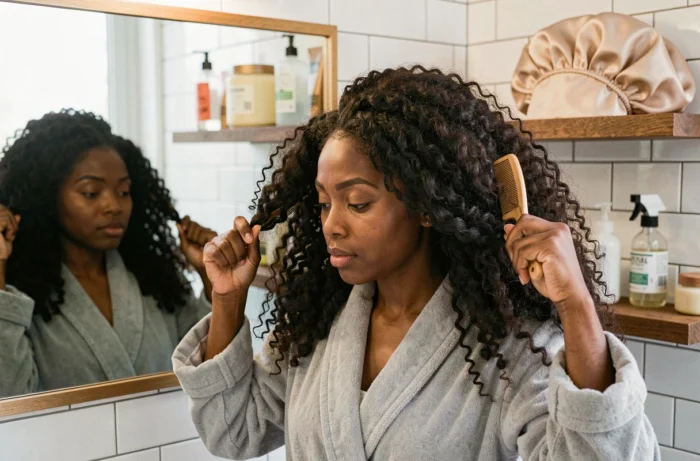
Curly to coily hair (types 3 and 4) features tight spirals or zigzags. Their very open cuticle allows internal moisture to escape. Sebum, produced in normal amounts by the scalp, cannot travel the length of the hair due to the twists. This lack of natural lubrication makes these hairs structurally drier and more brittle.
You can learn more on Beauté Chic to delve into the subcategories of this classification, from 1A to 4C.
Porosity and thickness: two often overlooked hair criteria
Limiting oneself to the shape of the hair when choosing care products is like only looking at the body of a car without opening the hood. Two people with identical curls can have radically different needs if their porosity or thickness differs.
The water glass test to assess porosity
Porosity refers to the hair’s ability to absorb and retain water. There is a simple test: place a clean hair strand in a glass of water and observe its behavior after a few minutes.
- The hair floats on the surface: low porosity, the cuticle is very closed. Treatments penetrate poorly, and oils remain on the surface.
- The hair sinks slowly to the middle of the glass: medium porosity, the most common situation. The hair absorbs and retains moisture properly.
- The hair quickly falls to the bottom: high porosity, often caused by coloring, chemical straightening, or prolonged sun exposure. Water enters easily but exits just as quickly.
This test provides an indication, not a medical diagnosis. Field reports vary on its absolute reliability, but it remains a useful first filter before investing in targeted products.
Hair thickness: fine, medium, or thick
Thickness corresponds to the diameter of an individual strand. A fine hair barely feels between the fingers, while a thick hair resists when rolled. A fine hair does not tolerate overly rich treatments well: shea butter masks or heavy oils weigh it down and remove all volume. In contrast, a thick hair absorbs these formulations without issue and gains real benefits from them.
Thickness does not depend on shape. You can find both straight and fine hair as well as curly and fine hair, each with very different care needs.
Tailored hair care routine: what each hair type demands from the scalp
Many hair care routines focus on the lengths and neglect the scalp. This is a mistake. The health of the scalp determines the quality of the fiber that emerges from it.
Straight hair: extend washes, lighten formulas
The abundant sebum on straight hair encourages frequent washing. A gentle sulfate-free shampoo allows for less frequent washes without a cardboard effect. Conditioner should be applied only to the ends, never to the roots, to avoid a flattened effect. Treatments with light proteins (hydrolyzed keratin) strengthen the fiber without weighing it down.
Wavy hair: hydrate without flattening the wave
Waves lose their definition when the hair is dehydrated or overloaded with silicones. A light water-based treatment, applied to wet hair, helps maintain the natural wave. Air drying remains the most respectful method for wavy structures. Scrunching the hair (pressing it from bottom to top) encourages definition without heat or heavy styling products.

Curly to coily hair: nourish deeply, protect the fiber
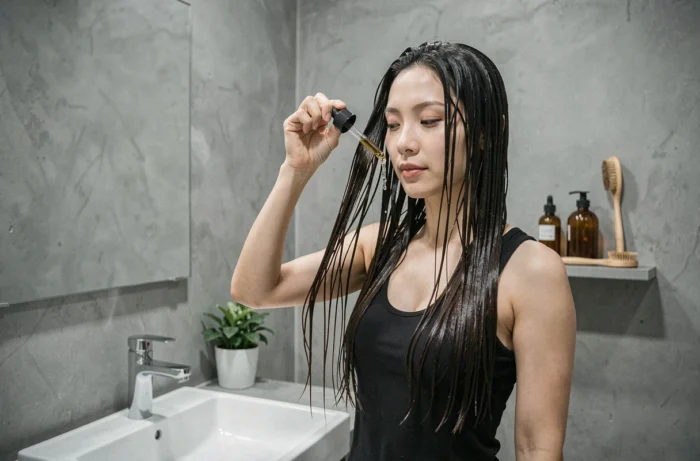
This hair lacks sebum along the lengths. An oil treatment before shampooing (pre-poo) limits moisture loss during washing. Conditioners rich in fatty substances (avocado oil, mango butter) compensate for the natural deficit.
- Detangle exclusively on wet hair saturated with conditioner, using a wide-tooth comb, to minimize breakage.
- Favor co-washing (washing with conditioner) between shampoos to avoid stripping the scalp.
- Protect the ends at night with a satin pillowcase or a bonnet, as the friction of cotton dries and breaks tight curls.
The ideal washing frequency varies from person to person, even within the same type. The condition of the scalp dictates the rhythm, not a fixed schedule.
Adapting hair care when the nature of the hair changes
A rarely discussed point: hair type is not fixed for life. Hormonal variations (pregnancy, menopause), certain medical treatments, and aging can change the shape of the follicle, the thickness of the fiber, and the production of sebum. Straight hair can become wavy after pregnancy, and tight curls may loosen with age.
This evolution makes definitive diagnoses fragile. Observing your hair once or twice a year, by repeating the air-drying test and the water glass test, allows you to adjust your hair care routine before damage (dryness, breakage, irritated scalp) sets in.
The most effective hair care is the one that responds to the current state of the hair and scalp, not to a label assigned ten years ago. Regularly reassessing your porosity and needs remains the best habit to adopt.


