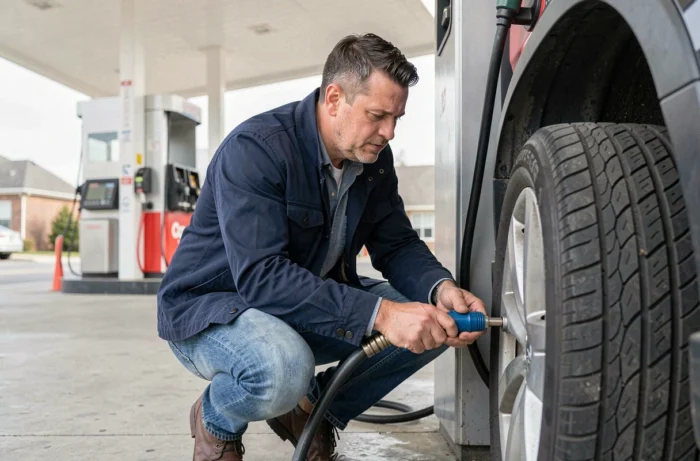
A car tire naturally loses pressure over the weeks, even without a puncture. Regularly checking and adjusting the tire inflation helps limit premature wear, reduce fuel consumption, and maintain proper handling. Several free solutions exist to perform this operation without spending a dime, as long as you know where to look.
Tire pressure and valve: what the station really measures
Before looking for a station, it’s useful to understand what happens during inflation. The device connects to the tire valve, measures the internal pressure in bar, and then injects or releases air until the target value is reached.
This reference value is found on a label affixed to the driver’s door frame or in the fuel flap. It varies depending on the axle (front or rear) and the vehicle’s load. Inflating all four tires to the same pressure without consulting this label is a common mistake.
The measurement should be done on cold tires, meaning after driving less than three kilometers. The heat generated by rolling increases the internal pressure and skews the reading. Parking near a station makes checking easier, rather than crossing the city to find one.
It is entirely possible to benefit from a free tire inflator at many locations across the country, provided you target the right spots.

Free tire inflator at gas stations: very variable policies
Gas stations remain the first reflex for drivers. The majority of them have an inflation station accessible in the parking lot, often self-service. TotalEnergies offers free service at the vast majority of its network. At large retail chains, the situation is more mixed.
E.Leclerc and Auchan provide free inflation at a notable proportion of their stations. In contrast, Intermarché and Carrefour offer free service at a significantly smaller share of their establishments. When the service is charged, the fee per session remains modest, but it adds up if checks are frequent.
The key point to remember: free service depends on the brand and location, not a national rule. Checking before heading out, via the station’s app or a simple call, avoids unpleasant surprises.
The case of highway rest areas
On highways, inflation stations are present at service areas. Regulations require their availability, and access is generally free. For long trips with a loaded vehicle, this is a relevant checkpoint, especially since the recommended pressure is often higher when loaded.
Auto centers and commercial zones: an underestimated network
Auto centers like Norauto represent an alternative that many drivers overlook. Some centers explicitly display the mention “free tire inflation” on their local listings, even without a purchase in-store.
This free service is not uniform. Availability depends on the center and not on a national policy. Some outlets have replaced their old stations with newer systems, sometimes paid. Online listings of local centers, regularly updated, allow you to check the service before heading out.
Commercial zones on the outskirts increasingly concentrate these free stations. This geographical shift is explained by the available space in parking lots and the desire of brands to attract in-store traffic. For drivers already shopping in the outskirts, inflation becomes an additional service accessible without detour.
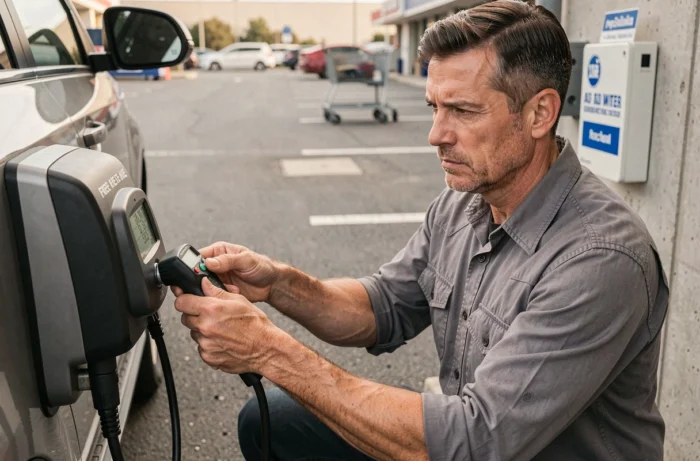
Wireless portable compressor: the solution to keep in the trunk
If no free station is immediately nearby, a portable compressor solves the problem sustainably. These wireless devices, powered by a rechargeable battery, can be stored in a glove compartment or the trunk.
Here are the criteria to check before purchasing:
- The maximum pressure capacity, expressed in PSI or bar. For a car tire, a device reaching 150 PSI easily meets the need.
- The inflation time for a standard tire. Compact models take a few minutes to compensate for common under-inflation, longer if the pressure is very low.
- The digital display with automatic shut-off at the target pressure, which prevents over-inflation and eliminates the need for a separate pressure gauge.
- The size and weight, which determine whether the device will actually stay in the vehicle daily.
The budget remains modest. Reliable models can be found for around thirty euros. The Xiaomi portable often comes up in user feedback as an effective compromise between compactness and performance. Brands like Oasser or Powools offer alternatives in the same price range.
Compressor maintenance
A portable compressor requires little maintenance. Recharging the battery every two months even without use extends its lifespan. Checking that the valve tip is not clogged before each use ensures a reliable pressure reading.
Frequency of checks and inflation mistakes to avoid
A pressure check every month is a reasonable rhythm. A tire can lose several tenths of a bar in four weeks without any visible anomaly. Waiting for the tire to appear visually deflated often means driving for a long time with insufficient pressure.
Two mistakes frequently occur:
- Inflating all four tires to the same pressure without consulting the manufacturer’s values, which often differ between front and rear axles.
- Measuring pressure after a long trip. The heat from rolling skews the measurement and leads to under-inflating the tire once cooled.
- Neglecting the spare tire, which remains stored for years without checking and becomes unusable the day it is needed.
Free tire inflation remains accessible to most drivers, whether at gas stations, auto centers, or with a personal compressor. The real cost is not financial; it’s the time not taken to check the pressure before a problem arises.


